
Society for UAP Studies Resumes Its Public Seminar Series, Foundations of a New Field
Society for UAP Studies Resumes its Academic, Public Seminar Series on Sept. 10 with Host Dr. Maya Cowen
SUAPS resumes free, biweekly UAP Studies Seminar Series on YouTube, hosted by Dr. Maya Cowan, examining how UAP research is developing as an academic subject
Biweekly program returns September 10, free and open to the public, livestreamed on YouTube
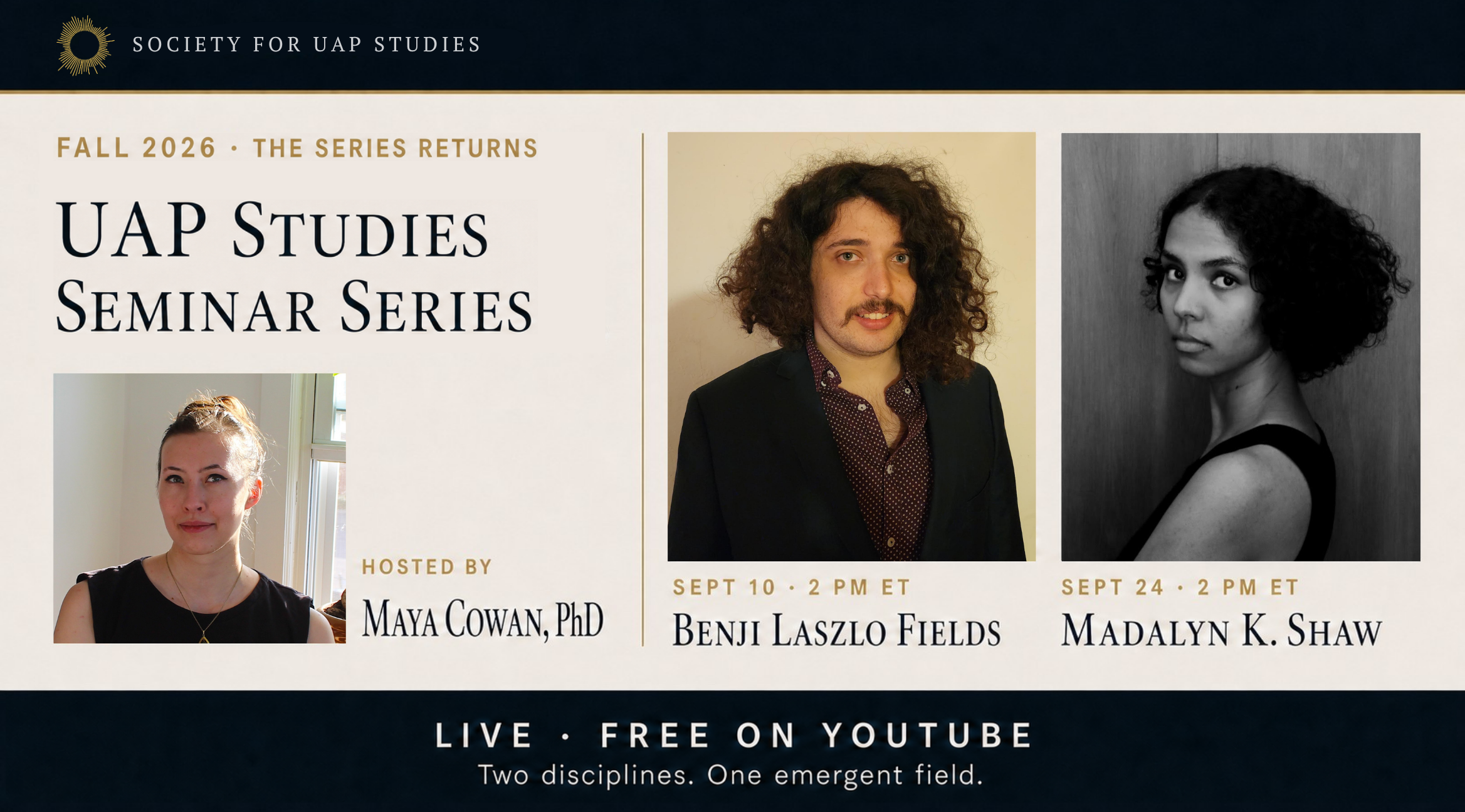
HOUSTON, Texas, Aug. 17, 2026. The Society for UAP Studies (SUAPS) will resume the UAP Studies Seminar Series: Foundations of a New Field on September 10, 2026. The series ran through the spring before pausing for the summer, time SUAPS used to confirm a new lineup and a new host. It returns every two weeks on Thursdays at 2 p.m. Eastern (1 p.m. Central), streamed live on YouTube. There is no cost and no registration required to watch.
Dr. Maya Cowan, a PhD in anthropology at Binghamton University, hosts the series. Sessions bring in researchers working across anthropology, aerospace engineering, physics, philosophy of science, and cultural studies to examine how the study of unidentified anomalous phenomena (UAP) is developing as an academic subject. That work is unfolding alongside new government transparency initiatives and data releases, which have widened the pool of material available for study.
"UAP studies sit at the intersection of science, culture, and curiosity, and that makes it a rich space for academic exploration," said Dr Maya Cowan, host of the seminar series. "My goal in bringing the series back is to give researchers a forum where they can look at UAP with real openness and real rigor. Taking the cultural side of this seriously isn't a detour from science. It's part of asking better questions and building better evidence."
Each session addresses one part of that inquiry: the theoretical foundations of UAP research, cultural and anthropological perspectives, standards of evidence, collaboration across scientific and humanistic disciplines, and the politics of how knowledge in this area gets made and legitimized. Sessions pair a research presentation with a moderated discussion, and most include a guest scholar.
"Bringing researchers from different disciplines into the same room, so to speak, is how this field actually gets built," said Dr. Michael C. Cifone, Founding Executive Director of SUAPS. "We don't get to shortcut the evidence. That's the whole point of doing this as a seminar series rather than a press conference: show the work, let people ask hard questions, and let the science hold up or not."
Fall 2026 lineup
September 10, 2026, 2 p.m. Eastern
Benjamin Fields, BA, is a researcher at NASA Goddard Space Flight Center and a research associate at the Blue Marble Space Institute of Science. He won the SETI Institute's 2022 Forward Award, has published in the International Journal of Astrobiology, and sits on the steering committee of NASA's Technosignature Study Analysis Group, with a background spanning optical SETI searches, Bayesian biosignature modeling, and technosignature strategy. His talk, "UAP in a SETI Context: Constructing Astrobiologically Plausible Origin Scenarios for ET Visitation," evaluates both local and interstellar origin scenarios against established SETI and astrobiology frameworks: what observational predictions each would need to meet, and how current UAP data measure up against those benchmarks.
September 24, 2026, 2 p.m. Eastern
Madalyn K. Shaw, a PhD candidate in the Department of Art History at the University of Toronto, presents "Photography, Evidence, and Imagination: Visual Culture in the UFO Movement." Shaw's dissertation research looks at UFO photographs not just as claimed proof or exposed fraud, but as cultural artifacts, and asks what that visual record can tell researchers about how the public has come to recognize, and argue over, what counts as evidence.
Further speakers will be announced through the fall.
Who the series is for
The series is built for university faculty, graduate and undergraduate students, researchers in related disciplines, science communicators, and anyone curious about evidence-based UAP inquiry. No specialized background is required, only curiosity and a willingness to think critically.
About Maya Cowan
Cowan's research focuses on the scientific study of UAP and on the emergence of UAP studies as a formal academic discipline, with particular attention to stigma, skepticism, and how evidence gets defined and gathered in this field. She has taught anthropology at Binghamton University and the University of Saskatchewan.
About the Society for UAP Studies
The Society for UAP Studies is a US based 501(c)(3) non-profit advancing the rigorous, interdisciplinary academic study of unidentified anomalous phenomena. Its Public Seminar Series brings researchers working at the frontier of the field to a general audience, free and open to all. Learn more at www.societyforuapstudies.org.
Deborah A West
Society for UAP Studies
+1 346-320-7693
email us here
Visit us on social media:
LinkedIn
Instagram
YouTube
Legal Disclaimer:
EIN Presswire provides this news content "as is" without warranty of any kind. We do not accept any responsibility or liability for the accuracy, content, images, videos, licenses, completeness, legality, or reliability of the information contained in this article. If you have any complaints or copyright issues related to this article, kindly contact the author above.
